
Search South Jordan Voter Registration
Start with the official Utah voter search. It is built for a voter to check his or her own record, not to browse the names of everyone in South Jordan. Enter the identifying fields, complete the challenge, and submit the form. The date of birth acts as a private match key. It is collected for the search but is not shown as an ordinary public-file field.
| Lookup control | Input type | Required | How to use it |
|---|---|---|---|
| First Name | Text | Yes | Enter the voter's given name |
| Last Name | Text | Yes | Enter the voter's surname |
| Date of Birth | Masked date | Yes | Supply the date used for registration |
| CAPTCHA | Challenge | Yes | Complete the anti-automation check |
| Search | Button | No | Submit after all required fields are complete |
A failed match does not prove that a person is unregistered. Check spelling, the birth date, a recent address change, and whether a new filing is still being processed. A South Jordan voter can then contact the Salt Lake County Clerk or update the registration through the authenticated state service. A separate address mode answers district, sample-ballot, official, and polling-place questions without serving as a voter-roll browser.
The live voter status form shows the exact fields used for a South Jordan voter registration search.
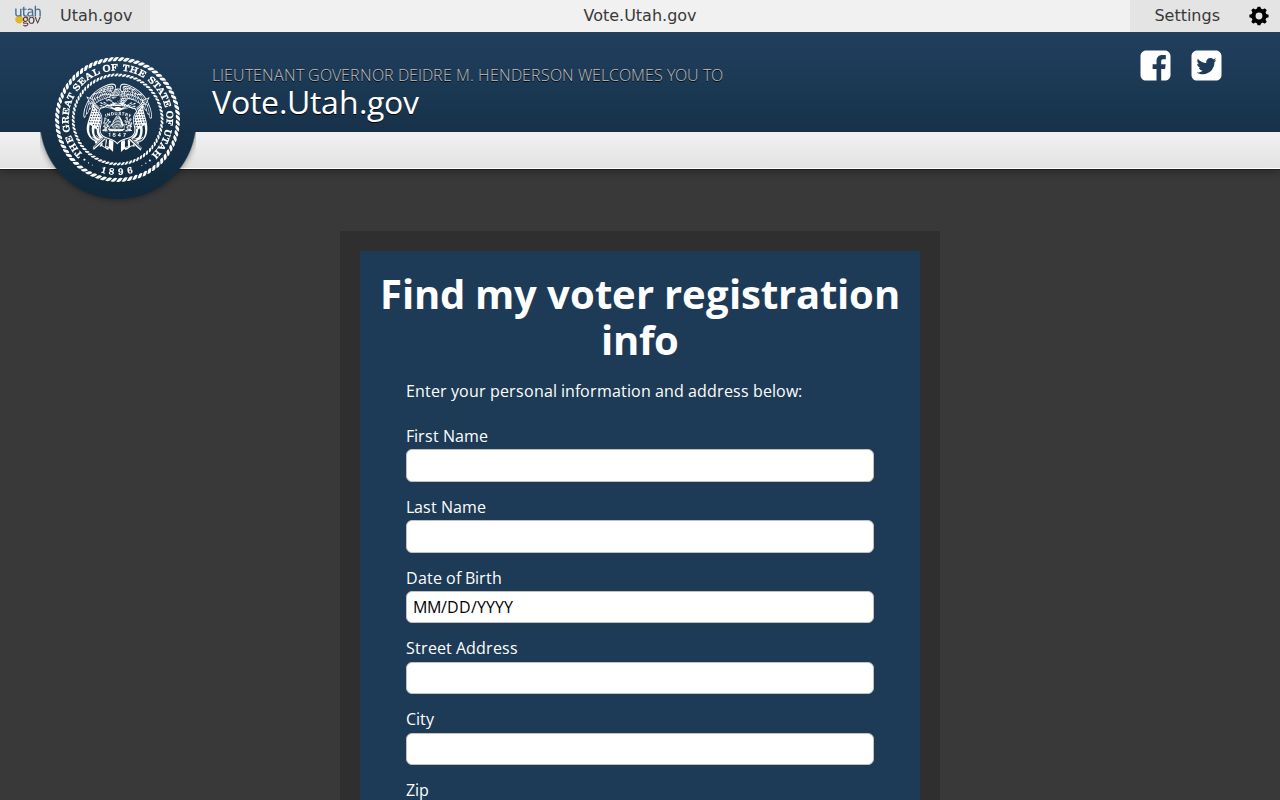
The captured form confirms that Utah requires a name, birth date, and CAPTCHA before returning the voter's own match.
South Jordan Voter Lookup Results
A successful self-match reaches well past the words “active” or “inactive.” The voter can review registration status and election-specific facts, track a ballot, identify elected officials, and find a polling place. Sample ballots also identify candidates and issues for the voter's assigned districts. Those results help a South Jordan resident correct a registration before relying on a stale address or precinct.
Keep the self-lookup and the bulk voter file separate. The self-service screen validates one voter. The statewide data product contains many voter records and requires a stated lawful purpose. Someone checking personal ballot status should not purchase a file, while a qualified requester seeking a defined district extract should not expect the self-lookup to perform that task.
Does a non-match settle registration status? No. Input errors, recent processing, and a privacy classification can affect the response, so the county clerk is the correct fallback.
South Jordan Voter Privacy Classes
Utah divides voter information by field and protection level. Ordinary file data can include a full legal name, residence, mailing address, age range, party, districts, status, and election participation. Sensitive application data stays outside ordinary disclosure. Utah also gives enhanced protection to At-Risk voters, which can cover eligible survivors or threatened people, law enforcement, people protected by court orders, armed-forces members, public figures, and qualifying co-residents.
Public, withheld, and At-Risk are not the same. Utah Code Title 20A, Chapter 2 withholds full birth dates, driver-license or state-ID numbers, Social Security numbers, email, phone, and signatures from ordinary public release. An At-Risk classification adds protection for eligible voters whose identity or location could place them in danger.
The official Utah voter privacy explanation shows the public and At-Risk classifications.
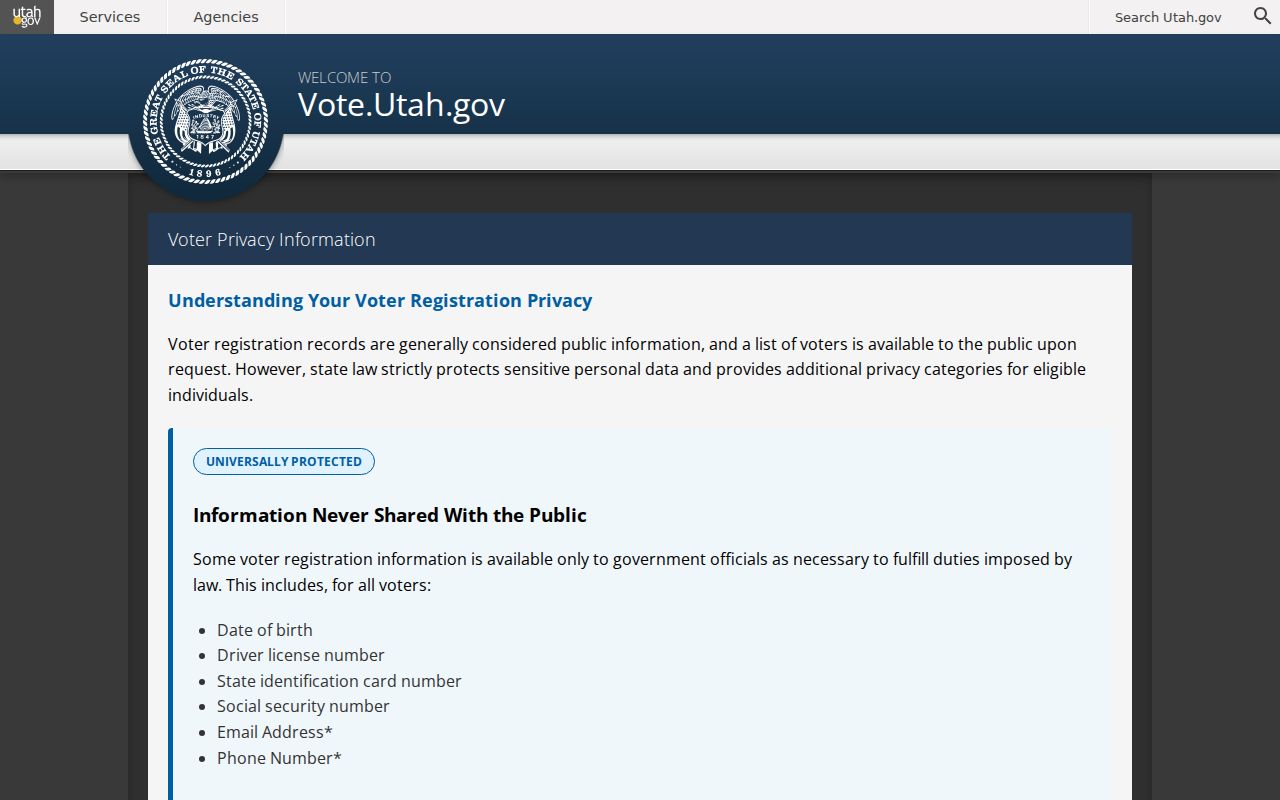
This privacy screen is the better source than an old request form because Utah's categories and disclosure rules changed in 2026.
Utah's Safe at Home program is a related but distinct safeguard. It gives eligible survivors a substitute address and mail forwarding. Neither Safe at Home nor At-Risk status should be treated as a casual opt-out from all old public history. Each protects defined current information under its own rules.
Fields in Utah Voter Records
The statewide-file inventory shows what a permitted data user may receive. It is broader than the self-lookup response, yet it still omits the sensitive identifiers that the registration form collects. District fields matter in South Jordan because one street address may tie a voter to several state, county, school, and city boundaries.
| Identity | Full legal name, voter identification number, and age range |
|---|---|
| Addresses | Complete residence with unit and a mailing address with city |
| Geography | County, precinct, congressional, legislative, school-board, county-council, and city-council districts |
| Affiliation | Registered party or unaffiliated status |
| Record status | Active or inactive and the last registration-update day |
| Participation | Elections in which the voter participated, never ballot selections |
The paper application asks for more than this public inventory. It collects citizenship and age eligibility, complete residence, birth data, identity-number evidence, prior registration, signature, and several optional or administrative choices. Collection by an election officer does not make each field public.
Note: Phone and email consent rules are scheduled to change in January 2027, so verify the current privacy page before requesting voter records.
Request South Jordan Voter Records
The Utah voter and election data page lists a one-time statewide registration database for $1,050. The file is tab-delimited, about 150 MB, and is normally delivered by emailed download within one business day. There are no refunds, subscriptions, or free updates. The statutory purpose rules still apply after payment.
- Choose the needed product and define the geography, fields, status, snapshot date, and intended statutory purpose.
- Use the state request for the statewide file. Ask the Salt Lake County Clerk for a South Jordan, county, precinct, or district subset.
- Complete the required purpose affirmation. For a county subset, request a written fee estimate because the statewide price does not establish the county charge.
- Review the delivery format and privacy rules before storing, sharing, or using the file.
The official request page displays the statewide file, election reports, formats, and current charge.
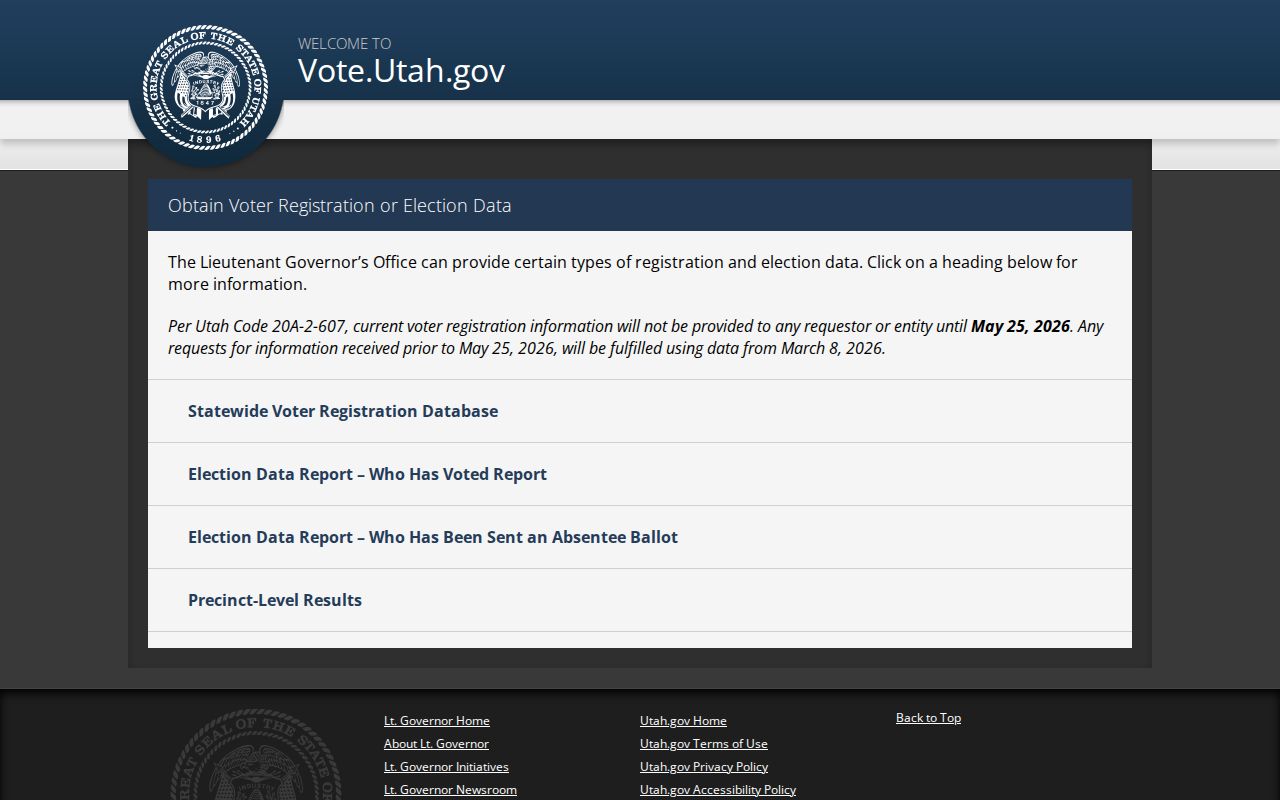
The product screen makes clear that a bulk voter file is a formal data request, not an open search box for South Jordan names.
County Route for South Jordan Voters
South Jordan is not the Salt Lake County seat. The Salt Lake County Clerk maintains the local registrations, while the Lieutenant Governor maintains the statewide database. South Jordan City Hall may hold municipal election records created by the city, but it is not the keeper of the county voter-registration subset.
A useful county request names the exact place and time. State whether the extract should include only active voters or active and inactive records, which fields are needed, the desired snapshot date, delivery format, and lawful purpose. The research did not verify a current Salt Lake County voter-file form or fee. Ask for a written estimate instead of applying Utah's $1,050 statewide price to a county product.
Corrections take a different path. A voter should update personal registration through the authenticated state portal or send the official paper form to the clerk. A data-file request does not change a record.
South Jordan Ballot History Limits
Participation history says that a voter took part in an election. It never reveals which candidate, issue, or ballot choice that person selected. That line preserves ballot secrecy while allowing election administration and authorized analysis of turnout.
Utah also offers a “Who Has Voted” report for $35 per election. It applies to regular even-year primary and general elections, not municipal odd-year elections or post-election requests. Daily tab-delimited delivery begins 21 days before an election and runs through the day before it. Fields include voter ID, name, residence, county, precinct or congressional district, voting method, processed date, and party. An absentee or mail-ballot-sent report follows the same timing and price constraints. Precinct-level result requests are listed with no fee.
South Jordan's 2026 Voter Snapshot
Utah's 2026 change is a timely warning against relying on old voter-file descriptions. Under Utah Code §20A-2-607, the official page said requests made before May 25, 2026 would receive the March 8, 2026 snapshot, with updated information resuming after that transition. The March 9 through May 25 pause was dated implementation policy, not a permanent freeze.
The same law stresses permitted purposes and At-Risk protection. Current Title 20A, Sections 601 through 607 should therefore control a new South Jordan voter records request. Older county forms may still show categories, prices, or access language that the Legislature replaced. Reopen the official state pages before placing an order.
Note: A dated snapshot can be correct for its release date yet still miss a later registration, update, inactivation, or district change.
Maintaining South Jordan Voter Rolls
Salt Lake County clerks process and maintain registrations that feed the statewide system. Outside the deadline-to-canvass period, the official maintenance description says clerks process forms within seven days. They verify identity, remove duplicate or interstate registrations, and remove a deceased voter within five days after notice.
Nonparticipation alone does not cause instant cancellation. After no participation in a federal cycle and no new registration, the voter becomes inactive and receives confirmation. Continued inactivity through another federal cycle leads to removal. Monthly sent, returned, and removal datasets are kept for two years. Removal-reason data begins in November 2025, which gives researchers a recent audit trail without exposing protected South Jordan voters.
State totals dated July 20, 2026 reported 1,778,184 active and 310,424 inactive registrations. Those are Utah figures, not South Jordan counts. A local analysis should use the Salt Lake County workbook and label its date rather than assigning the statewide total to the city.
Historical South Jordan Election Records
Utah treats the state voter registration series as permanent, identified in the research as State Archives series 28818. The state election-data collection also offers historical results, voter-information pamphlets, and election records. Older poll books and registration registers may sit with the creating agency, county, or Utah State Archives city and county records.
South Jordan incorporated in 1935, long after Salt Lake County record keeping began in 1852. A family-history search for an early resident may therefore need county or territorial geography rather than a South Jordan municipal label. Search archival catalogs by agency and election year, then confirm the series before requesting a copy.
The historical gap is real. No exact run of South Jordan poll books or voter registers was verified. Do not claim continuous years or a missing-record event without an archive finding aid.
Lawful Use of Utah Voter Data
Utah Code §20A-2-607 permits registered-voter information for a political purpose, an expressly permitted purpose, another use authorized by state or federal law, or a court order. It makes acquisition by false pretense and use for an unauthorized purpose unlawful. Public fields are therefore not a grant to market, harass, or republish voter data without limit.
Do not use South Jordan voter records to identify or expose an At-Risk voter, evade Safe at Home protection, stalk a person, or cause harm. Utah's stalking law, §76-5-106.5, covers a knowing or intentional course of conduct involving two or more acts when the required fear or distress standard is met. A first offense is generally a class A misdemeanor, with qualifying prior history able to raise the offense to a third-degree felony. Electronic communication harassment is separately addressed by §76-9-201.
Preserve messages, request details, URLs, and screenshots when voter-list data appears to have been obtained by false pretense or used for harassment. Report the issue to an election official or law enforcement. General Utah records-law classifications are covered separately in the South Jordan public records access overview.